Shevek’s alienation
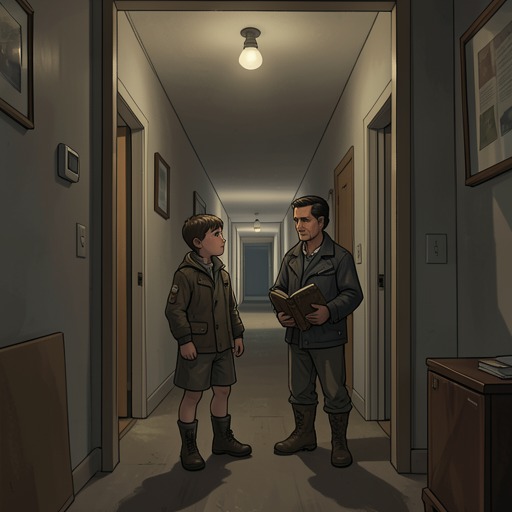
The DispossessedShevek’s alienation is a double exile: he belongs neither to Urras, the world he comes to love, nor fully to Anarres, the society from which he has separated himself through dissent. It is not simply loneliness or foreignness. His estrangement grows from a deliberate commitment to act by his own choice, from the different social worlds encoded in the two societies’ language and customs, and from political boundaries that make his hoped-for role as a bridge between worlds uncertain.## Identity and Origins Shevek understands his isolation as the consequence of a chain of choices. After Takver and the children leave for Peace-and-Plenty, he spends hurried days exchanging final messages with people on Urras and discussing plans with Bedap and others. Although he feels as if events are carrying him rather than being directed by him, he recognizes that his own will set this course in motion. He traces the decision back five years, to a night with Takver in Chakar, when he said he would go to Abbenay and unbuild walls, and further back to the famine years in the Dust, when he promised himself that he would act only by free choice.
That resolve has brought him to a small room that feels like a prison. The room’s effect makes the immediate confinement part of a much longer history: the decisive walls are not only physical, but also the divisions among people and societies that he has set out to challenge. His alienation therefore carries agency as well as cost. He has not merely been displaced; he has chosen a course whose risks include separation from familiar social ties and institutions.## Urras and the Stranger’s View In his first encounters with Urrasti people, Shevek discovers that ordinary explanations often rely on premises he does not share. Dr. Kimoe’s account of religion, for instance, treats the absence of churches and creeds as the absence of religion. Shevek’s response—that Anarresti cannot be stones—reveals how differently they understand the question. As Kimoe struggles to clarify what he means, Shevek sees that the disagreement concerns more than a definition: each man takes for granted relationships the other cannot readily see.
The same friction surfaces in their language for social rank. Shevek asks whether status is the same as class, and Kimoe cannot readily explain status to him. Shevek notices that Urrasti writing often uses higher to mean better, whereas an Anarresti would use more central. Such differences turn social hierarchy into a problem of perception as well as of institutions: a word that seems self-evident in one society may expose an unspoken value when encountered from another.
Shevek’s attention to language becomes especially intimate when he considers Pravic, his only language, and its lack of proprietary idioms for sex. Its usual verb has a plural subject and can be translated neutrally as copulate; it does not present one person as having or possessing another. Yet Shevek recognizes that a grammar of non-possession cannot contain every human experience. He remembers that both he and Beshun had sometimes felt they possessed one another, but that neither owned the other. In his recollection, her eventual goodbye and release of him make freedom a lived relation, not merely a linguistic principle. His alienation thus does not amount to confidence that Anarresti concepts explain everything; he can see both the power of a social vocabulary and what it leaves out.
His encounters with Urrasti ideas of gender make the gap sharper. When Shevek notes that Odo was a woman, he sees in the men around him an animosity rooted in a relation of possession: they know no relation but possession, and are themselves possessed by that order. Their praise of the virtuous woman as an inspiration does not reassure him; he turns away and asks for books. From his outsider’s position, idealizing women and subordinating them appear not as opposites but as expressions of the same structure.## A Double Exile Shevek’s most complete reckoning with his estrangement comes in the old Senior Faculty House. The room is beautiful, humane, and centuries old; scholars have lived and worked there for generations, long before the Settlement of Anarres. Its continuity makes him confront the histories and inherited labor that sustain Urras. He comes to love the world, but feels he has no right to its bounty and is not part of it. At the same time, he is not at home in the world of his birth.
He understands this as a double separation. The Settlers of Anarres turned away from Urras and its past; Shevek has gone further, exiling himself from his own society. He had thought he might serve to bring together two worlds to which he belonged to neither. The hope is not dismissed as meaningless, but the scene strips it of easy assurance: personal insight and goodwill cannot by themselves erase the historical and social distance between the worlds.
The moon offers a brief point of recognition across that distance. Shevek remembers seeing it as a child with Palat, over the Dust, and with Takver above Abbenay. The memory joins places and relationships through a shared celestial sight, but the moon outside the Urrasti windows is not the same moon. The image holds connection and separation together: time is continuous, while worlds remain distinct.## Political and Social Boundaries Alienation also takes institutional form. When A-Io and Thu are officially at war, Shevek learns that wartime restrictions apply even though the two states will not invade one another. Research at the College of Noble Science may be classified, publication delayed, and travel—especially for non-nationals—limited. Shevek’s host claims he can get around the rules, but the exchange makes plain that Shevek’s presence and movement are subject to permissions established by a state whose society he is still trying to understand. His foreignness is not only cultural; it can be used to narrow what he may do.
The popular news from Benbili briefly seems to open a different kind of connection. A newspaper’s large, excited type reports the rebels’ advances in a compressed present tense that makes the events seem immediate. Shevek follows the revolution with growing intensity and hopes when he reads that prisoners have been freed. Yet A-Io’s announcement that it is sending armed reinforcements to support the government forces him to see how a distant struggle is entangled with the power politics around him. Sympathy with revolt does not give him control over the forces acting in its name.
At the Nio Esseia demonstration, the divide becomes violent. Helicopters drown out the speaker and the crowd; gunfire strikes people near the Directorate, and the panicked crowd presses toward shelter. Soldiers enter the building after the shooting, where the word DOWN has been written in blood on the foyer wall. Shevek’s attempt to reach beyond the political order meets a spectacle in which collective speech is overwhelmed by state force. The episode sharpens the difference between being physically present in a society and having a secure place within its political life.
The Terran embassy offers him refuge under a different jurisdiction. Its representative explains that the embassy is accredited to the Council of World Governments, not to A-Io, and that the castle counts as Terran soil. She calls this a diplomatic fantasy: a room in a tower in Rodarred, on Urras, eleven light-years from Earth, is treated as territory belonging to Terra. The refuge is real, but the explanation makes belonging seem contingent on a political fiction that states agree to recognize. Shevek can seek protection there, yet he remains a visitor whose safety is mediated by institutions and jurisdictions.## Return and the Unfinished Bridge Shevek’s alienation persists beyond Urras. In a discussion of whether he can return to Anarres, Rulag invokes the Terms of the Closure of the Settlement: no one will be allowed off the freight ships farther than the boundary of the Port of Anarres. Bedap challenges her claim that Shevek cannot come back, and an adviser suggests the terms were meant for Urrasti rather than Anarresti. Rulag rejects that distinction: a person coming from Urras is Urrasti. The rule makes origin a political classification, not simply a matter of birthplace or personal allegiance.
Against that boundary, Shevek’s own way of presenting himself is an appeal to giving rather than purchase. On Urras he says he has brought nothing, has no money, and cannot buy food; if he is to be kept alive, his hosts must give it to him. He calls himself the Beggarman and describes his presence as making Urrasti behave like Anarresti: giving rather than selling. Later, when he arrives at the home of Atro and Saio Pae, he again explains that he comes empty-handed because Anarresti use nothing the hosts lack. These exchanges show that his estrangement is not an inability to engage with others. He makes his difference explicit and turns it into an invitation to practice another kind of relationship.
But an invitation is not the same as belonging. Urras can treat him as an honored guest while restricting his travel; Anarres can claim him as its own while its settlement terms restrict entry. His effort to unbuild walls therefore meets barriers on both sides, even as his choices keep open the possibility of connection. Alienation is the condition from which he tries to act, and the cost that accompanies his attempt to make relations between separated societies possible.